Museum of Contemporary Art Tokyo
(U) is an Audio / Visual Installation involving you and your iPhone. By the simple act of plugging in your phone, private data, including GPS coordinates of where you've been and photos, are "syphoned" into the system and visualized on the iPad. We tend to forget what our phones do not, (U) attempts to remind the participate of this while making your data momentarily public in the gallery space.
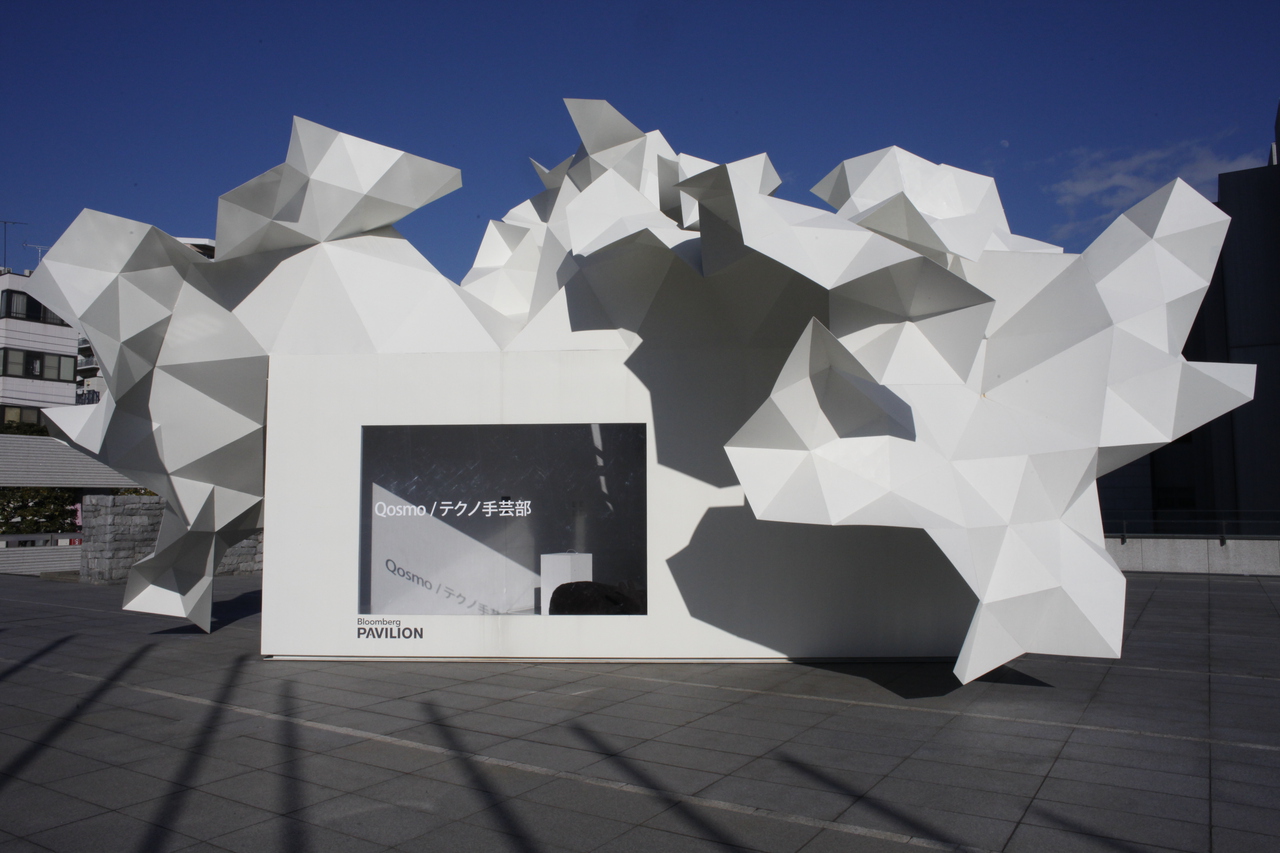
Shown at the Bloomberg Pavilion, designed by Akihisa Hirata, for the MOT.

Why I made this piece
At Qosmo we are constantly working on apps for smartphones. For iOS or Android, for an advertisement campaign or product, we try to push the boundaries of the device and what consumers expect. As developers we are acutely aware of the information we have access to, and could potentially use to hone advertisement campaigns.
Smart phones (iPhone, Android, etc.) have changed how we store data. Think back to the heyday of analog phones. Your contact list was an address book or rolodex, singular and usually stationary. The storage medium was paper, difficult to gain free physical access to and time consuming to copy in bulk. Now our contact lists are digital, saved on our phones, synced to our computers and stored in the cloud. If you lose or upgrade your phone, don't worry, all your data will be restored from the cloud. In essence, our data - our phones' memories, so to speak, have been extended beyond their physical instantiations. Beyond the address book they store our music, email, when we ran (if you use Nike gear), photos, and even more importantly, GPS data. Our phones are an abbreviated, punctuated version of our lives. In making (U) we hope to remind the visitor how interwoven our lives and smartphones have become.
The second chord we hope to strike upon came from asking ourselves these questions: If our phones could talk about us, what would they say? If they had personalities would they come to resemble a digital version of ourselves like the caricatures of pets and their owners? If ten years from now we die and our children or grandchildren (or those we don't know) look through our phones will our personality pervade through the device?
The most visceral experience of art occurs when it connects to something deep within our psyche.
There is also something romantic in the notion that the viewer must participate in the work to complete it. Akihisa Hirata designed a beautiful pavilion for the Museum of Contemporary Art Tokyo, where (U) was displayed. We focused our attention on how we could connect the space and (U) to the viewer. The answer was simple: through the data on visitors phones.
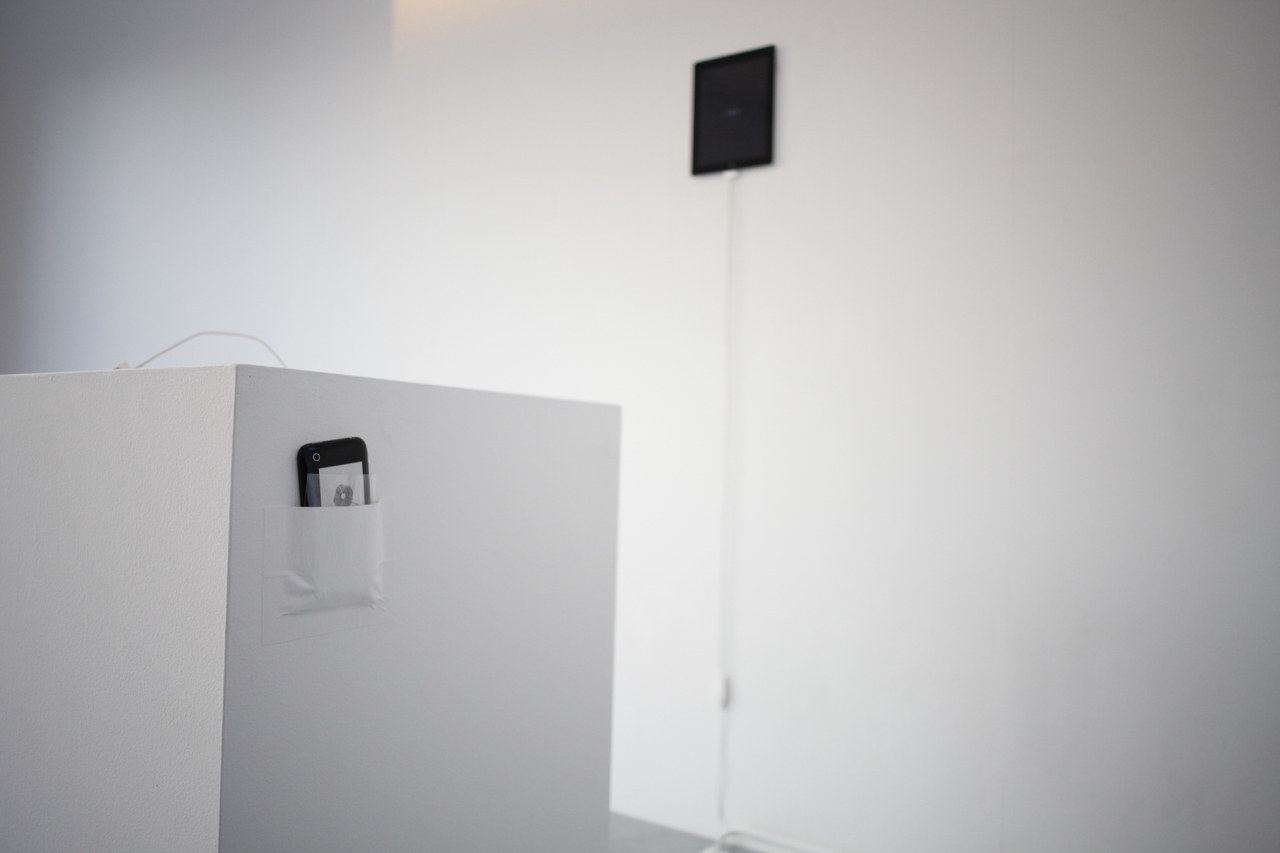
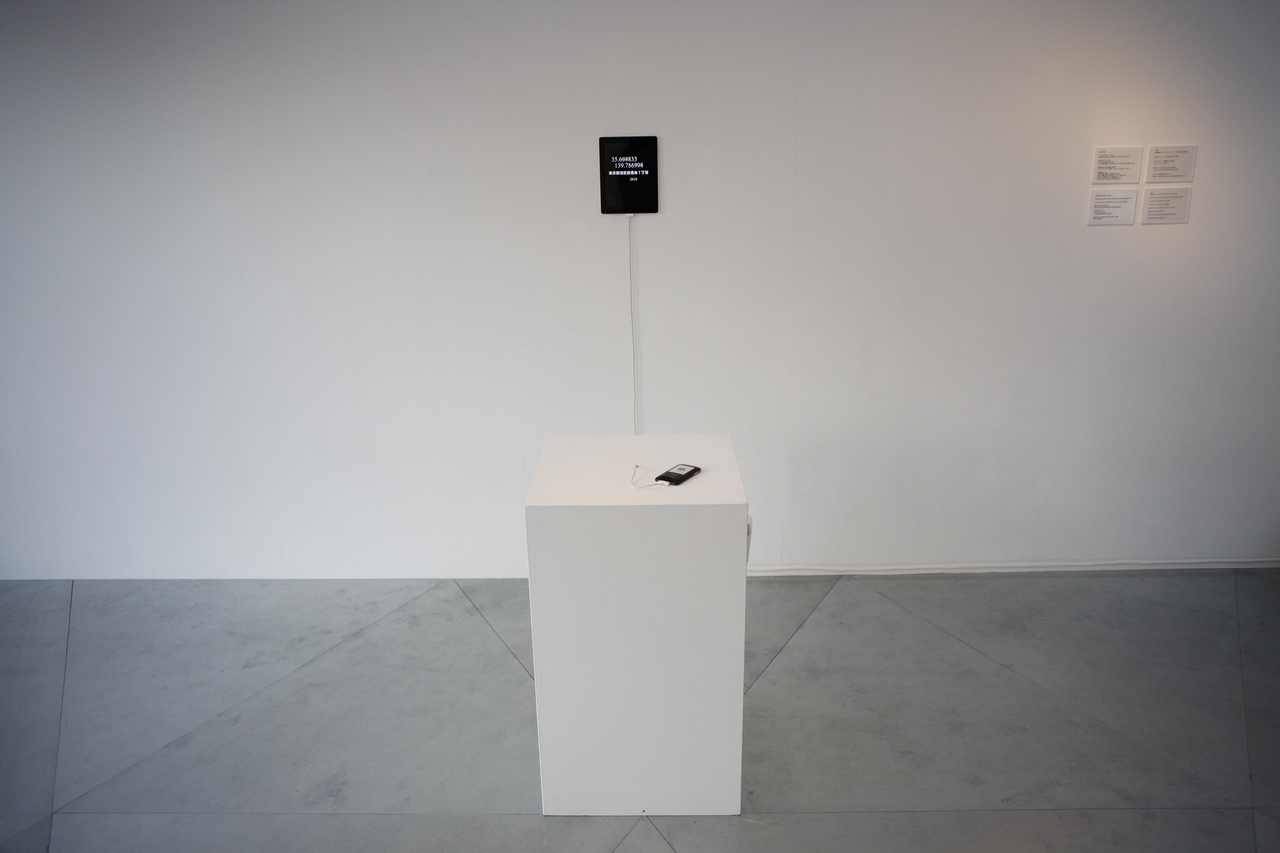
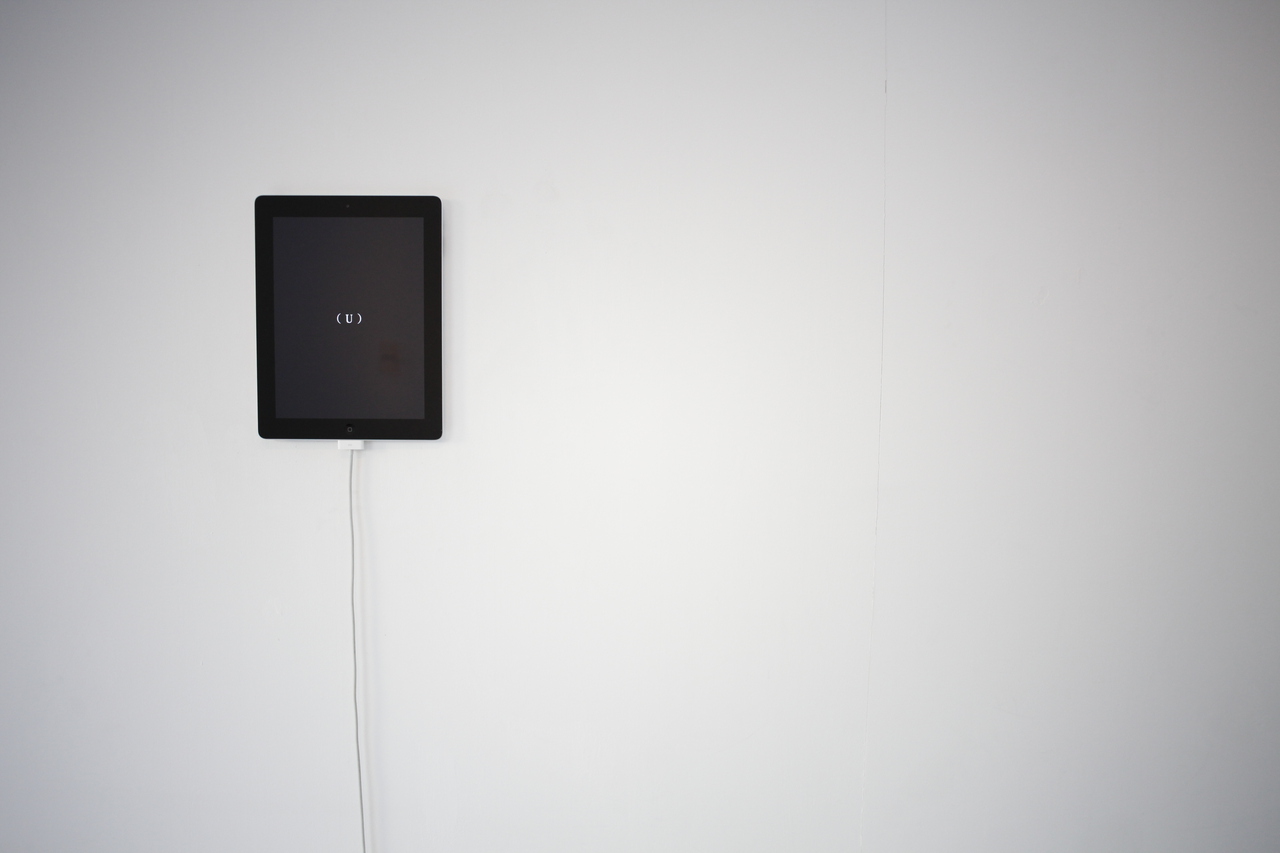
A pedestal was designed and placed in the center of the space. Out of its center snakes an iPhone cable, its head resting listlessly, beckoning a mate. On the wall in front of the pedestal is an iPad, seemingly floating on the wall. (U), white text on a black screen, is matter-of-factly displayed. Without a participate the piece is a motionless monolith. Once the cable finds a mate, the piece comes alive.
As if awakened, sound fills the space. Taeji Sawai (partner at Qosmo, sound artist, known for collaborating with the Boredoms and Daito Manabe) created the sound for (U) which is integral to the experience. First data is sucked into the monolith. The visualization begins with GPS coordinates, dates and specific addresses (in Japanese) of where you've been. In its second stage photos are mixed in, and finally the piece crescendos with a rapid fire display of photos. (U) ends with the iPad reminding you, 'Do you remember that day? I'll never forget'.
By showing specific addresses of where the viewers had visited, we attempted to remind them of the depth of information stored on their phones. By then making this, and their photos viewable in the gallery the participant became a part of the piece, but more importantly those attentively watching suddenly had a voyeuristic window into a strangers life. This was potentially humorous, revealing and embarrassing.
The photos displayed are random, and some visitors ripped out the cable suddenly reminded of 'something' they may not want seen (there is a warning on the plate introducing (U)). With (U) one can remove the cable to stop the piece, but on the web we are unable to fully track or control how all our data spreads through the ether. By using 'free' sites such as Facebook or Twitter we are sharing access to our data in exchange for a service. (U) is an attempt to remind us of forgotten details embedded in our data (such as addresses) and how we are often unaware of how they may be viewed, 'mined' or distributed.
Being in the space and watching visitors reactions to (U) from a distance was fascinating. Some were hesitant to expose their data while their friends were present, but curious enough to come back later alone. Watching people use (U) offered a glimpse into personalities: did they relish the attention? Or as soon as the photos started popping up get the jitters and rip out the cable? As I've noticed with the expression of personal biometric data (like the Butterfly Dress) viewing ones photos through (U) gives a new impression of familiar data.
On the unexpected side I imagined most people had GPS tagging enabled. Apple asks the user whether to enable location services the first time the device is turned on after purchase. I don't know the exact number, but I'd say close to half of the visitors had it turned off. Often, they weren't even aware of this fact, as it had been enabled later on a per app basis (iOS asks you each time a new app requests location data, and is enabled only for that app). I imagine different cultures have varying degrees of openness in regards to enabling location based services.
Given the timeline to complete the project (weeks), and the space (museum funded by tax revenue) the scope of data we could use was limited. In future versions we plan to delve deeper, more starkly posing questions about private data in public spaces. I am also particularly interested to see how various cultures (New York vs. Berlin vs. Shanghai) react to the piece.
(U) is a robust patchwork of custom software. To explain the pieces I'll start from the plugging in of the iPhone. A daemon monitoring USB connections detects that an iPhone was connected and mounts the device as if it were another file system. Once the iPhone is accessible another program launches and inspects the phones contents, determining if there are enough photos or GPS data to visualize (U). At the same time a message is sent to the iPad via OSC telling the (U) app that a device has been connected and to start playing music. Speakers are embedded into the pedestal for superior sound quality.
The core of (U) runs on a MacBook Air inside the pedestal and is written in openFrameworks (c++). Several programs do different tasks during the initial loading phase: extracting GPS data (bash), reverse geocoding (PHP, lookups are cached to keep query count low), photo resizing / downsizing (c). The MacBook Air and iPad communicate wirelessly via OSC, and the iPad app is written in objective-c. Everything except for the iPad app is written to be instance based; once the iPhone is removed all the instances die, are restarted, and any saved data is deleted.
(U) also has a small red button. In installation environments, anything and everything that could possibility go wrong will; machines need to be restarted. The iPad app is easy: kill the app and restart it. The MacBook Air on the other hand, is hidden in the pedestal. So in case something goes wrong (which it will when you're dealing with low level device communications where the cable is suddenly removed while data is being copied) the gallery staff can just hit the red button.