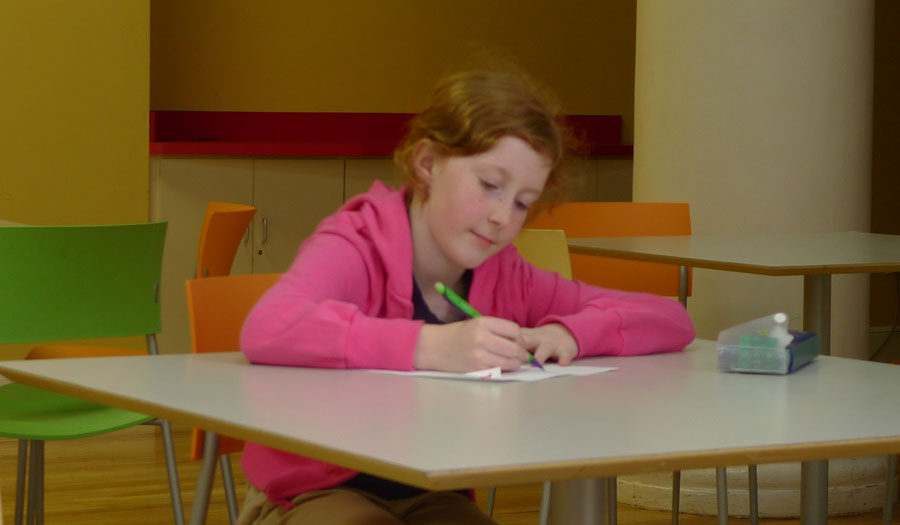
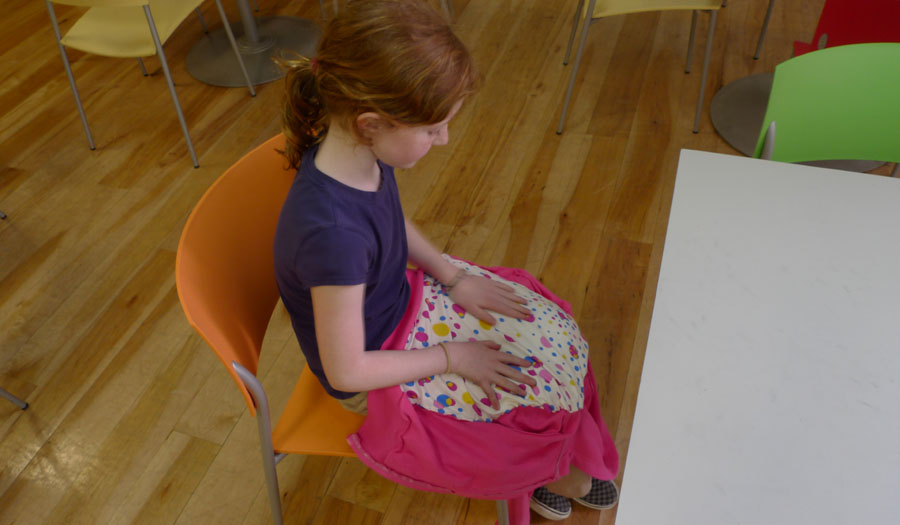
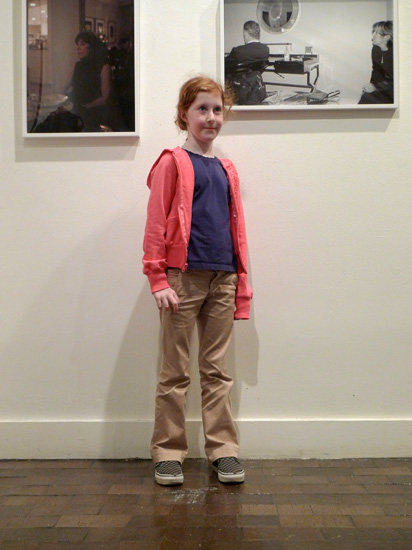
'Sophie's Pet' provides sensory feedback in the form of vibration to improve self-regulation of sitting posture while also providing calming sensory input for children with autism.
'Sophie's Pet' was developed specifically for children with autism who demonstrate poor posture at a desk or table. Individuals with autism often have reduced postural control (Molloy, Dietriech, & Bhattacharya, 2003; Minshew, KiBum, Jones, & Furman, 2009). This project combines feedback stimulus indicating improper posture with sensory stimulation to facilitate muscle contraction through the back, while simultaneously organizing the sensory system. The goal of the project is, first, to increase the ability of the student to correct her posture independent of external cues from individuals in her environment, such as the teacher or teacher's aide. Second, the goal is to reduce the frequency of improper sitting posture.
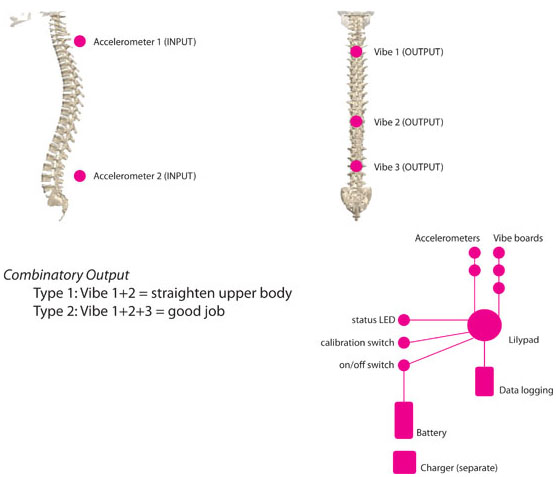
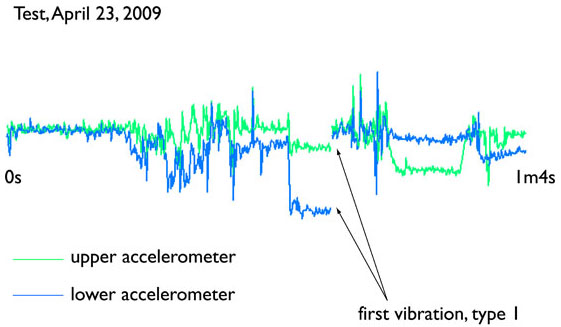
The design of 'Sophie's Pet' is as follows: two sensors are used to detect postural deviation. One sensor is placed at the base of the spine, near the sacrum, and the other sensor is at the upper thoracic level, between the shoulder blades. When the sensors recognize a deviation beyond a specified threshold it triggers vibration. Three vibrators are placed along the middle of the back at the upper thoracic level, the lower thoracic level, and the lower lumbar region. Different intensities of vibration and duration are used for the dual purpose of posture correction and sensory diet. Positional data and haptic output are recorded to monitor progress.
It is difficult for children with autism to maintain good posture. 'Sophie's Pet' stimulates with vibrations, making it easier to shorten the muscles of the back, and aligning sight, hearing, and perception.
The purpose of 'Sophie's Pet' is to:
1) To reduce the burden on teachers and guardians and enable them to improve their posture by themselves.
2) Reduce the number of times your posture deteriorates.
3) Work on perceptual cognition and provide proprioceptive sensations.
4) It should function as clothing and be unobtrusive. Reduce social distance for children.
Two sensors are attached to the back, and the state of the posture is confirmed by comparing the data. Three vibration motors on the back vibrate when the spine exceeds a certain angle. There are two vibration modes for postural improvement and proprioceptive stimulation. Posture data and vibration responses are stored on a micro SD card so that effects can be measured. Different children react differently to vibrations, and depending on the case, they may or may not feel discomfort. Match both the vibration level and the cloth to the child.
Cotton, polyester, conductive ribbon, padding, custom circuit, rechargeable battery, Lilypad.
Size: Children's S
Collaborators: Karri Fisher, Diana Mott
Sophie's pet: cotton, embroidery, conductive strands, custom printed circuit boards, batteries